R&D NOTE 001 / POLYMIND
I used two AI personas to review my website.
The saved run cost $0.09 and found concrete problems. It still needs a single-agent baseline and human scoring.
01 / THE INTERNAL BRIEF
I wanted an actionable review of the launch page.
I had just launched a new website and wanted to know whether a new visitor would understand it, whether the page contained anything worth sharing, and what to change before promotion. I asked for a prioritized diagnosis with reasons.
PolyMind lets me define reusable personas, send them the same brief, collect their positions independently, and pass both responses to a separate facilitator. The transcript keeps the two perspectives and the synthesis visible.
I chose my own website because I knew the product well and was likely to overlook problems in material I had written myself.
“This is the website I just launched. What do you think about it? Will it have a good social media response? Tell me why not and what could be improved.”
I pasted the page copy and services guide into the session so the review used a fixed input.02 / THE ROOM
The personas used different review criteria.
Mara Chen
Social audience researcherShe evaluates how real audiences interpret and act on a page, prioritizing audience behavior over the builder’s assumptions.
Dex
Indie hacker and launch lurkerHe is skeptical of hype, seduced by a strong demo, impatient with vaporware, and quick to ask whether anything actually shipped.
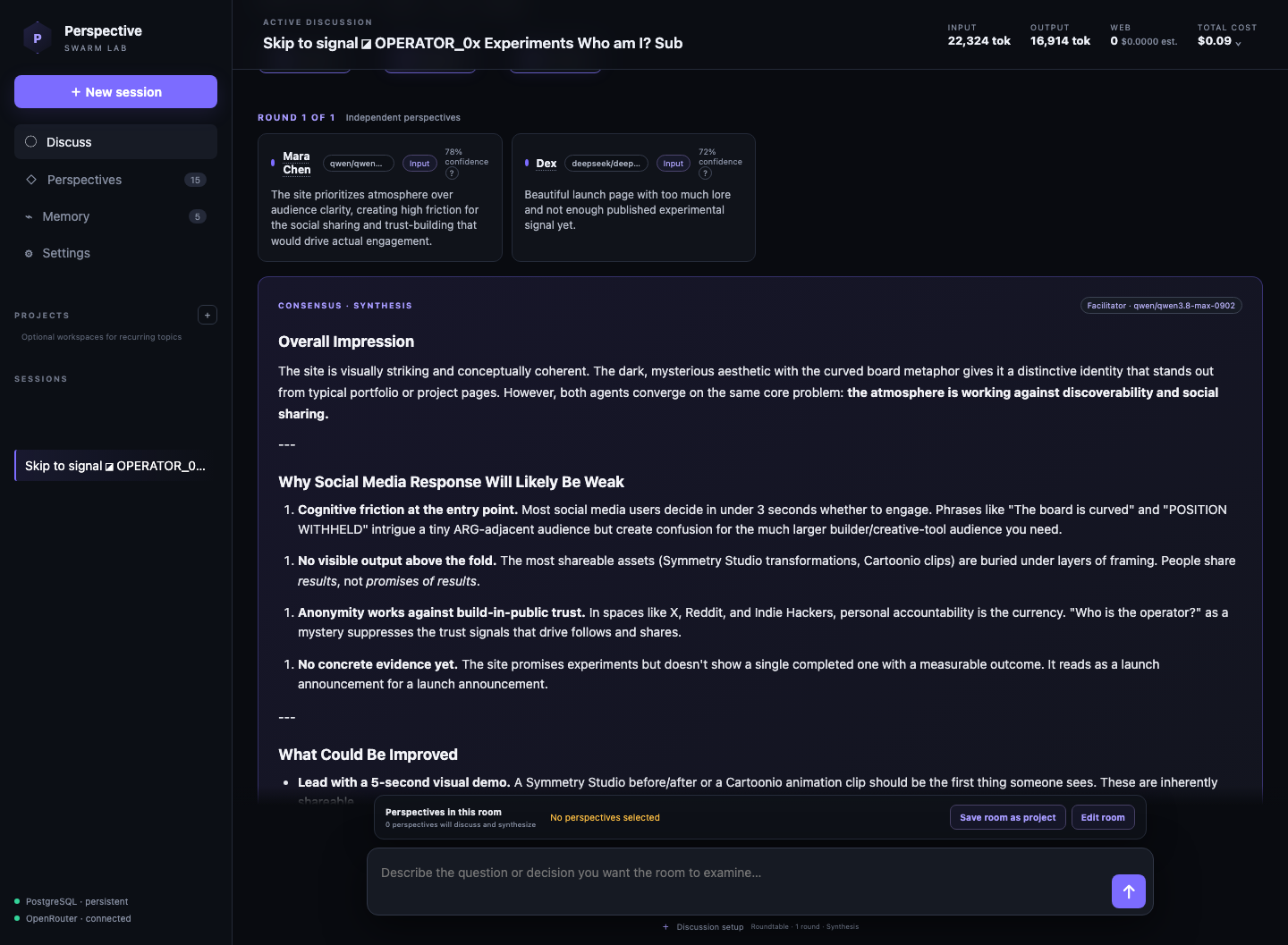
Mara reviewed audience clarity and trust. Dex reviewed shipped output, speed, and evidence. They wrote independent responses before the facilitator received either position.
03 / THE VERDICT
Both reviews found the same visibility problem.
Both personas liked the visual identity and found the service offer difficult to locate. The homepage gave more space to atmosphere than to shipped work, which left Symmetry Studio transformations and Cartoonio clips below several layers of framing.
The recommendation was to show a result, a number, and one primary action near the top of the page.
I rewrote the homepage around the service, production evidence, and separate sections for shipped products and research.
The visual design, the honest project stages, and the principle that good work leaves an inspectable trail.
Lead with a five-second visual result, one concrete number, and one primary action.
A real case study with the prompt, setup, cost, outcome, and failure attached.
The run produced a prioritized homepage diagnosis and a saved transcript for this note.
04 / LIMITS AND NEXT TEST
This run cannot establish that two personas outperform one.
The experiment was a self-review of one page. It had no user study, A/B test, single-agent baseline, repeated trials, or blinded human ratings. Two personas may share model biases or converge on the framing supplied in the prompt.
In a later run, the agents criticized a domain without accessing the page. The facilitator recorded that limitation, but the output still had no evidential value as a website review.
The saved conversation displayed 22,324 input tokens, 16,914 output tokens, and $0.09 in total model cost across several turns. These are session totals; the run was not a controlled benchmark.
Run a fixed brief through one agent and the two-persona workflow, repeat both conditions, and ask blinded human reviewers to score the outputs.